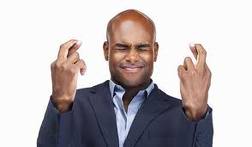
Superstitions, as aforementioned, are a set of beliefs or practices that aren't based on fact, experience or rationale. It remains in most cultures because of fear or faith, however, it's not founded on results. There are cultural, cross-cultural, personal and religious superstitions.
Superstitions in the American culture:
Do not walk under a ladder, it will bring bad luck.
Breaking a mirror it will bring seven years of bad luck.
A groom can not see his bride before the wedding, because it's bad luck.
A bride must have something old, something new, borrowed and blue before she weds, otherwise it's bad luck.
It's bad luck if a black cat crosses your path.
It's good luck to carry a rabbits foot.
Knock on wood three times if someone says something unfavorable/unkind.
Say "Bless you" if someone sneezes, for good luck.
The 13th floor in any building is bad luck.
The number 13 is bad luck.
The dialog below is a good example of how to apply the phrases above. You can role play using the dialog below.
Teacher Jenny and her students are looking at the meaning of "superstition" in their E.S.L. class.
Teacher Jenny: Last class we were supposed to cover "describing people", however, we ended up covering "taboo subjects". This was great because we were able to cover a topic I would not have otherwise covered. On account that some of you confused "superstitions" with "taboos", I have decided to cover "superstitions" today.
Student 2: That's great! I went home from the last class we had and I thought about some superstitions in my culture.
Teacher Jenny: That's great! You are one step ahead of me. I was just going to ask everyone to think of some superstitions in their culture. Here is a handout with a list of some American superstitions. Please pass it around. Thank you.
Student 2: I am Korean and in my culture we believe that you will have bad luck if you see crows in morning before school or work.
Teacher Jenny: That's very interesting... Thank you for sharing. Crows are bad luck in the American culture too. It's probably because of the nature of crows themselves. Anyone else?
Student 3: I am from India and in my culture we believe that if you look at a picture of your mother's face or God just after waking up then it will bring good luck the entire day.
Teacher Jenny: That's a really good one! As a mother, I am lead to believe that it true. He he he. Thank you for sharing.
Students: (All laughs).
Teacher Jenny: Would anyone else like to volunteer?
Student 1: In the Chinese culture we believe that on Chinese New Year everyone must open all the windows in their house to let the old year old out and the new year in.
Student 4: Can I share something?
Teacher Jenny: Sure! Please go ahead.
Student 4: In the Japanese culture "umeboshi" means pickled plum and in my culture we believe that eating umeboshi everyday will bring luck.
Teacher Jenny: Thank you. Now I will share. I believe most of you already know this but in the American culture we believe that if a black cat crosses your path it will bring bad luck. To avoid bad luck one should turn around and go the other way.
Student 4: We believe the same thing in Japan.
Teacher Jenny: That's interesting! I believe most cultures share a lot of the same superstitions, because of the cross-cultural exchange. As you all know, many countries have historical and cultural ties and because of immigration and colonization a lot of these cultures have the same beliefs and/or superstitions.
Student 1: I agree. I can see that from the list on your handout.
Teacher Jenny: Thank you for coming today everyone! Great job! See you all tomorrow.
Now your turn!
Make a list of some superstitions you know and role play with a friend or family member using the outline below.
You: In my culture we believe ____________ (state the superstition).
Your friend: Why is that?
You: We believe that because ____________ (explain).
Your friend: That's very interesting. In my culture/country we believe _________ (state the superstition(s)).
You: Could you explain why you believe that?
Your friend: We believe that because ________ (explain).
You: We have the same belief./That's interesting!
Great job today!


